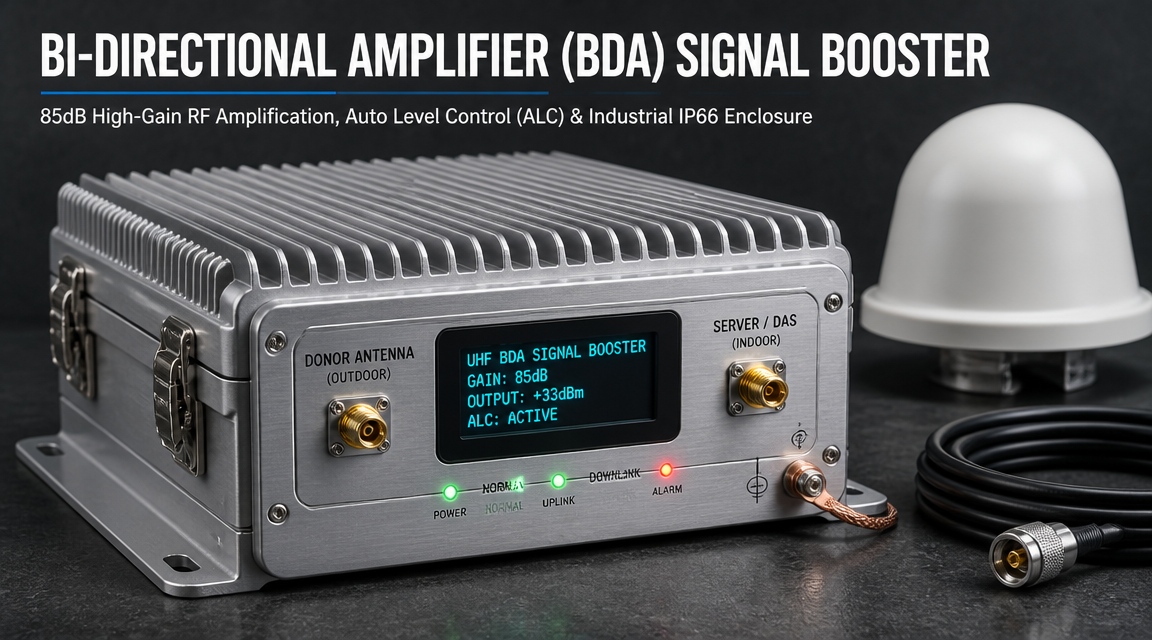
Plant signal booster selection: compliance, band matching and coverage
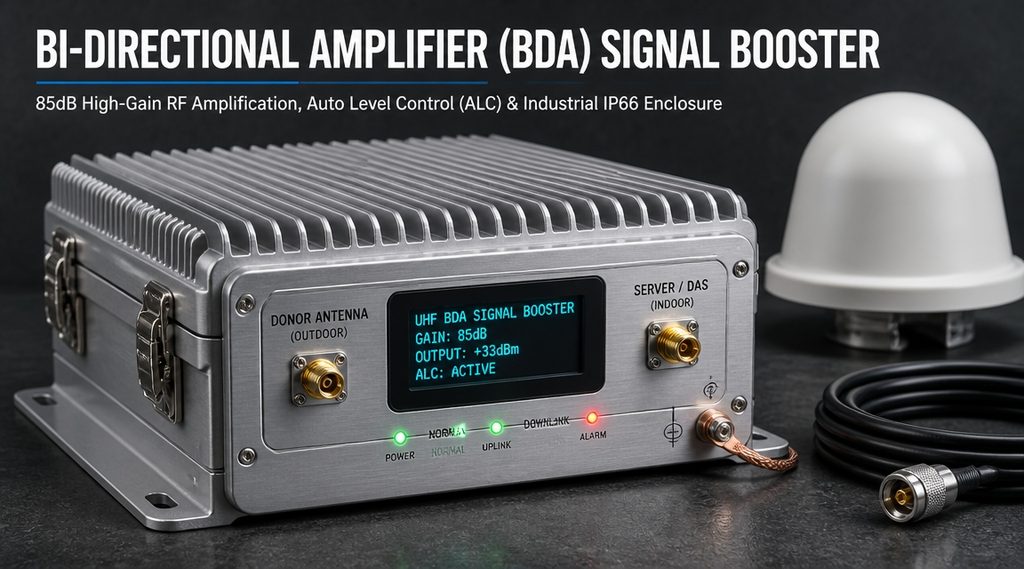
A plant signal booster fills holes inside coverage that already exists. That single sentence decides whether you may buy one at all.
The device is regulated, and the rules are unusually specific. Power, noise figure, passband and labelling are all written into the text.
This guide walks through the rule, the band choice, the installation risks, the coverage estimate and the daily routine.
If the plant sits outside any licensed coverage area, read the repeater guides instead. A booster is not the tool for that job.
What a booster is, and is not
The regulation defines it precisely, and the definition explains most of the buying rules.
The definition in the rule
47 CFR 90.219 defines it as a device or system that automatically receives, amplifies and retransmits signals from wireless stations into and out of building interiors, tunnels, shielded outdoor areas and other locations where those signals would otherwise be too weak.
Two words matter: automatically and retransmits. It is not a base station, and it does not create a channel.
Booster against repeater
A repeater has its own licensed channel and its own identity. It creates coverage where none existed.
A plant signal booster re-transmits what it hears, on the same channel, with no change in occupied bandwidth.
That is why a booster cannot be licensed to serve a new site. It has no channel to be licensed on.
When it is the wrong purchase
- The plant is outside the licensed service contour.
- There is no usable donor signal at the building.
- You need a second talk path, not more field strength.
- You need coverage in a new building two kilometres away.
In each case the honest answer is a repeater on its own channel, or a second site.
Compliance: who may operate it
This section is not paperwork. It decides whether the installation is lawful on the day it is switched on.
Consent in writing
The rule allows a licensee to consent to operation by non-licensees, such as a building owner or an installation contractor.
Non-licensees must obtain the express consent of the licensee for the frequencies being amplified.
That consent must be kept in a recordable format, presentable to an FCC representative or to another licensee investigating interference.
An email trail is enough if it names the frequencies and the site. A verbal agreement is not.
The 5 W ceiling
Each retransmitted channel is limited to 5 W ERP, on the forward link and on the reverse link.
Both links matter. Most installations tune the downlink and ignore the uplink, which is where interference usually starts.
The rule also states that a plant signal booster may not extend the station service contour. Coverage outside the contour is a violation, not a bonus.
Class A and Class B
| Class | Passband | Practical meaning |
|---|---|---|
| Class A | No passband above 75 kHz | Channel specific, narrow, easier to keep clean |
| Class B | A passband above 75 kHz | Wideband; fixed sites only; must be registered |
The 75 kHz line is the whole classification. A narrow channelised unit is Class A; a wideband unit covering a whole band is Class B.
Registration for Class B
Class B installations must be registered in the FCC signal booster database. Class A units are not subject to that requirement.
Registration is not a substitute for consent. Both apply, and they are checked separately.
The label you should see
The rule requires a label stating that the device is not a consumer product and is for licensees and qualified installers.
It must also state that operation requires a licence or express consent, and that Class B units must be registered.
If the carton has no such label, the product was not built for this market. That is the first thing to check in a quotation.
Technical limits written into the rule
Four numbers separate a compliant unit from a cheap one. Ask for each of them in the quotation.
Noise figure: 9 dB or better
The rule caps the noise figure at 9 dB in either direction. That is a device specification, not a suggestion.
A noisy amplifier raises the noise floor of the whole site. Users then hear a hiss where they used to hear nothing.
Ask for the figure for both links. A datasheet that quotes only the downlink has answered half the question.
Intermodulation and noise limits
| Emission | Limit |
|---|---|
| Intermodulation products, ERP | −30 dBm in 10 kHz |
| Noise inside the passband, ERP | −43 dBm in 10 kHz |
| Noise more than 1 MHz outside the passband | −70 dBm in 10 kHz |
| Spurious emissions | −13 dBm within 100 kHz |
These are the numbers an inspector would measure. They are also the numbers that decide whether the neighbours complain.
Same channel, same bandwidth
The unit must retransmit on the channels it receives, with no change in occupied bandwidth.
It must also keep the retransmitted signal inside the unwanted emission limits that apply to what it received.
That rules out “cleaning up” a signal by re-modulating it. A plant signal booster is a pipe, not a translator.
Band matching
Most failed projects fail here. The passband has to match the licence, not the catalogue page.
Start from the licence
Write down the exact frequency range on the licence, including the mobile transmit side.
A duplex system needs both directions amplified. A unit that covers only the base transmit range is half a system.
Then confirm the unit’s passband sits inside that range, with margin for channel spacing at the edges.
Channelised or wideband
A channelised unit amplifies the channels you name. It rejects everything else, including interference from nearby users.
A wideband unit amplifies the whole band. It is easier to install and much harder to keep clean.
The rule asks for the minimum passband that does the job. That sentence favours channelised equipment in a plant.
Why the 75 kHz line matters for DMR
A 12.5 kHz DMR carrier sits well inside a 75 kHz passband. A channelised unit therefore fits comfortably as Class A.
A wideband unit crossing the line becomes Class B, with fixed-site and registration obligations attached.
If a supplier cannot say which class the product is, the compliance file is already incomplete.
Mixing services in one passband
The rule discourages a Class B passband that covers both commercial mobile services and land mobile channels.
The exception is a distributed antenna system installed in a building, where a shared infrastructure is the point.
For a single plant, keep the passband to your own band and avoid the argument entirely.
Installation and interference risk
Every installation risk here has the same root: the amplifier hears its own output.
Donor and server isolation
Isolation is how much the server antenna’s signal is attenuated before it reaches the donor antenna.
It must exceed the booster gain. If gain is 80 dB and isolation is 70 dB, the unit amplifies itself.
Measure it with the booster off: inject a signal at one antenna and read the level at the other.
What oscillation sounds like
Users report a howl, a pulsing roar, or a carrier that blocks the channel with no audio.
The booster’s automatic gain control may keep it running at reduced output, so the fault hides as poor coverage.
A plant signal booster in oscillation can hold the repeater’s input open. Everyone on that channel loses the site.
Uplink noise and the repeater’s floor
Every amplifier adds noise. On the uplink, that noise arrives at the repeater along with the wanted signal.
If the added noise is comparable to the repeater’s own noise floor, receive sensitivity drops for the whole site.
The symptom is subtle: handhelds that worked at the gate now only work in the yard. Measure the floor before and after.
Strong nearby transmitters
A plant beside a broadcast site, a paging transmitter or another radio user has a hard problem.
A wideband front end can be driven into intermodulation by signals you do not care about.
Channelised equipment helps, and so does a narrow donor antenna pointed away from the offender.
Placement rules that work
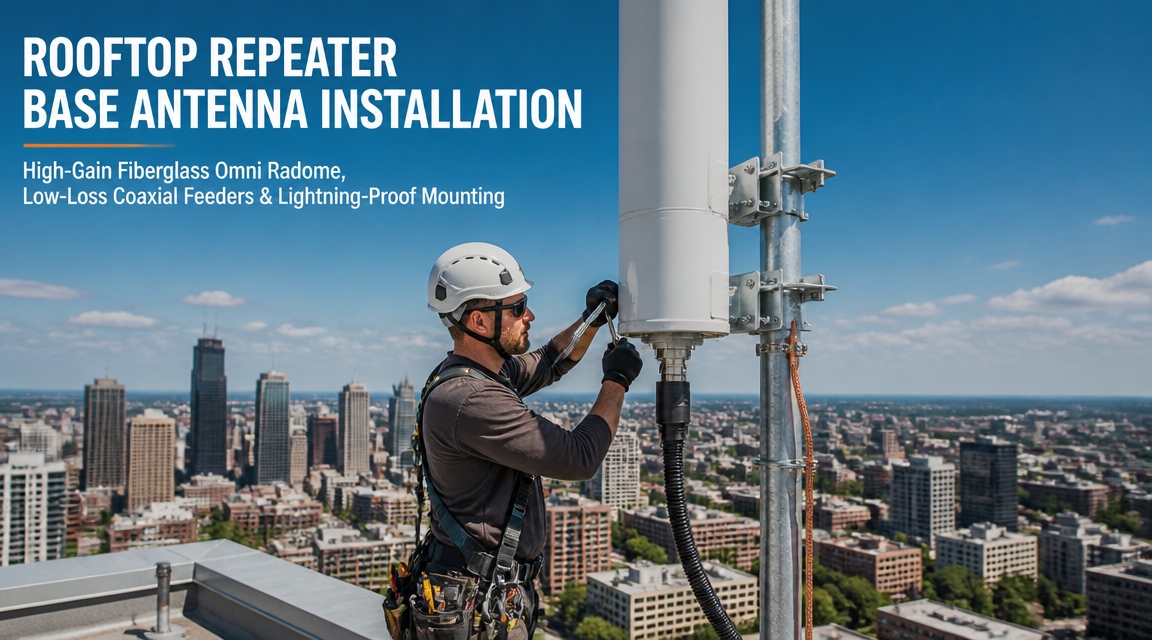
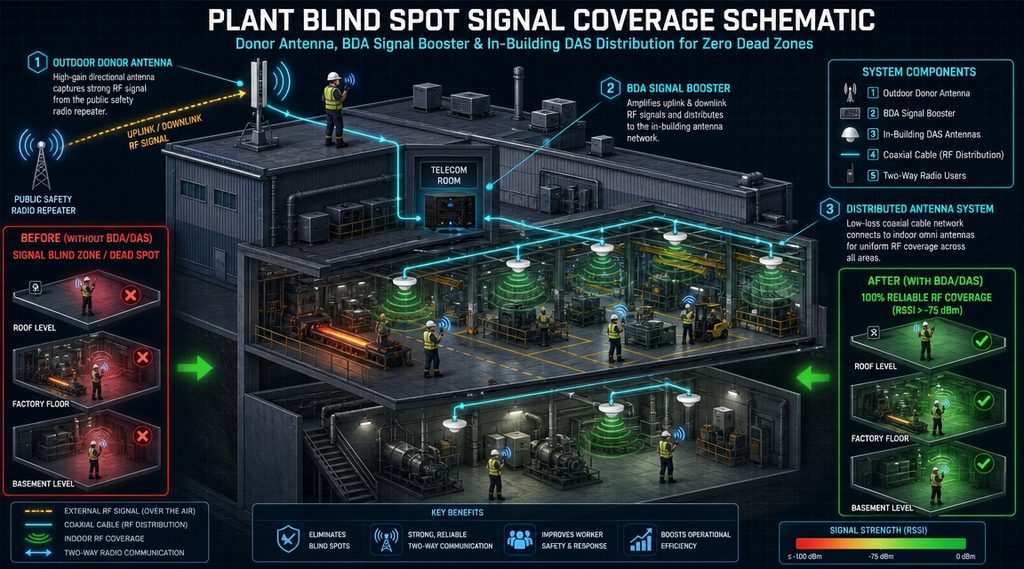
- Donor antenna outdoors, directional, aimed at the licensed site.
- Server antennas indoors, facing away from the donor.
- Maximum physical separation, with building structure between them.
- No donor antenna on the same wall as a server antenna.
- Nothing aimed across a roof at the donor direction.
Coverage estimation
Estimate first, measure second, and keep the estimate for the commissioning record.
Start from the weak area
Walk the plant with a handheld and mark where coverage fails. That map is the requirement.
Note the fail points in order of importance. A loading bay matters more than a storage corner.
Measure the donor signal at the proposed antenna position. Without a usable donor, no amplifier can help.
The dB arithmetic
| Element | Example | Note |
|---|---|---|
| Donor signal at the antenna | −95 dBm | Measure, do not assume |
| Donor feeder loss | −2 dB | From the cable datasheet |
| Booster gain | +80 dB | Set below the isolation figure |
| Server feeder loss | −3 dB | Include splitters |
| Server antenna gain | +3 dBi | Indoor omni or panel |
Add the gains and subtract the losses to get the level at the server antenna. That figure is the design starting point.
Then subtract the path loss to the furthest user. Measure that loss on site; do not import a number from another building.
Leaky feeder or antennas
A leaky feeder suits long corridors, tunnels and rack aisles. It radiates along its length and follows the geometry.
Discrete antennas suit open bays and high ceilings, where one panel can see a large volume.
Both are limited by the 5 W ERP ceiling. If the area needs more, add antennas, not power.
Why the ceiling shapes the design
With a fixed maximum ERP, the only way to cover more space is to spread the same power over more antennas.
That means more splitter loss and more cable. The design becomes a distribution problem, not an amplification problem.
This is why a plant signal booster quotation should show an antenna schedule, not just a box.
Commissioning record
Commission the site once, and write down what you measured. That record is what proves the installation is legal and working.
What to measure
| Test | How | Pass condition |
|---|---|---|
| Donor level | Spectrum analyser at the donor antenna port | Enough for the planned gain |
| Isolation | Booster off, signal one way, read the other | Above the set gain |
| Output power | Power meter at the server port | At or under 5 W ERP per channel |
| Noise floor | Repeater input, booster on and off | No measurable rise |
| Coverage | Handheld walk test, same route as the survey | All marked fail points cleared |
Set the gain below the isolation
Turn the gain down until the margin is at least 10 dB. More margin is better than more power.
Record the final gain setting on the unit and in the file. Nobody should have to guess it later.
Keep the label and the manual
The rule requires a label with a specific warning, and the same warning in the manual, packaging and point-of-sale material.
Keep the manual with the compliance file. An inspector can ask for it years after installation.
Daily operation and maintenance
Most booster faults show up as a coverage complaint, not as an equipment alarm. Watch for the pattern.
A monthly check that takes ten minutes
- Confirm the unit is powered and no alarm LED is lit.
- Key a handheld at the furthest point and listen for howl or pulsing.
- Compare the signal bar reading with the commissioning sheet.
- Look for new construction, new racking or a new metal roof nearby.
- Check the donor antenna for corrosion, water ingress and loose hardware.
Seasonal items
Water in a connector is the most common outdoor failure. Check tape and boots before the rainy season.
Lightning damage often appears as a dead unit after a storm. Bond the mast and use surge protection at the entry point.
Thermal drift matters in an unventilated cabinet. Keep the unit within its rated temperature range.
Label every cable at both ends. The next technician will not have your notes, only the labels.
Photograph the installation after commissioning. It settles most arguments about what was there before the fault.
When coverage quietly degrades
Three causes cover most cases: a changed donor path, a failing feeder, and a new interferer.
Re-measure the donor level first. If it has dropped, the problem is outside the building.
If the donor level is unchanged and coverage still fell, suspect the server side: a splitter, a connector, or an antenna.
Change control
Any change to channels, gain or antennas should go back into the commissioning record.
A booster set up for one channel plan and later tuned to another may no longer match its class or its consent.
Record who holds the admin password and who may change gain. Uncontrolled tuning is how a compliant site becomes a complaint.
What to ask before you sign
A quotation for a plant signal booster should answer eight questions. If any answer is missing, treat the price as provisional.
Eight questions for the supplier
| Question | Why it matters |
|---|---|
| Which class is the unit, A or B? | Decides registration and site rules |
| What is the exact passband? | Must sit inside your licence |
| What is the noise figure on each link? | Caps at 9 dB either way |
| What gain range can be set? | Must go below site isolation |
| What is the maximum output per channel? | 5 W ERP is the ceiling |
| Who provides the consent letter? | Required in recordable form |
| Is the label supplied, and in what language? | Required on device and packaging |
| What antenna schedule is included? | Coverage depends on distribution |
Documents to receive
Ask for the datasheet, the manual with the required warning, and the test data behind the emission limits.
Ask for the serial number in writing. A booster without a traceable serial is hard to defend in an inspection.
If the unit is Class B, ask for the registration reference before it goes on the wall.
Red flags in a quotation
A quoted gain figure with no isolation plan is a red flag. So is a coverage promise in square metres.
Beware of any unit sold as “no licence needed”. The rule regulates the device and the site, not only the frequency.
Beware of a price that excludes antennas, cable and commissioning. That is where the work actually is.
Ask what happens if the site fails its walk test. A supplier who offers only a box will charge for every visit afterwards.
Frequently asked questions
Is a booster the same as a repeater?
No. A repeater is a licensed station on its own channel pair. A booster amplifies existing channels without adding capacity.
If the problem is capacity rather than signal, the answer is a repeater or more channels.
Can we install it ourselves?
Installation is technically simple and legally constrained. The consent and the site rules are the difficult parts.
For a leased building, confirm the landlord’s position before drilling for a donor cable.
Does a booster help a dead zone behind a concrete wall?
Yes, if a usable donor signal exists outside that wall. That is the case it was designed for.
No, if the whole site is outside coverage. Then the donor has nothing to amplify.
Will it interfere with the neighbouring plant?
Only if it is misconfigured, over-driven, or oscillating. Correct isolation and gain settings prevent all three.
Keep the commissioning record. It is the evidence that the installation was correct on the day it was signed off.
How long should it last?
Treat the outdoor parts as consumables. Connectors, jumpers and antenna hardware fail long before the electronics do.
Budget for a connector and jumper replacement cycle, and inspect after every storm season.
Contact Us
Send us your licence range, the weak areas on the plant map, and the channels in use. We will tell you whether a plant signal booster is the right purchase or whether a repeater is the honest answer.
Contact our sales manager directly.
Sales Manager: Kevin
WhatsApp: +852 60731163
WeChat: +8616623617128
Email: fengfanannie@163.com