Radio voice recording: local memory, console archive and the rules between them

Radio voice recording arrives as a checkbox on a quotation and becomes a governance problem six months later.
The buying question is narrow. Does the audio sit inside the handheld, inside the dispatch system, or in both?
The answer decides who can retrieve it, how long it survives, and what happens when someone asks for a copy.
This guide covers both architectures, the storage arithmetic, export mechanics and the compliance points that most projects miss.
Two places a recording can live
Almost every commercial system uses one of two paths, and a few use both.
In the radio
Local recording writes audio to memory inside the handset or mobile. It needs no infrastructure and no network.
The radio records what its own receiver hears, which is exactly what the user heard at that moment.
That is its strength in an incident review. It is also its limit, because nobody else has the file.
At the console
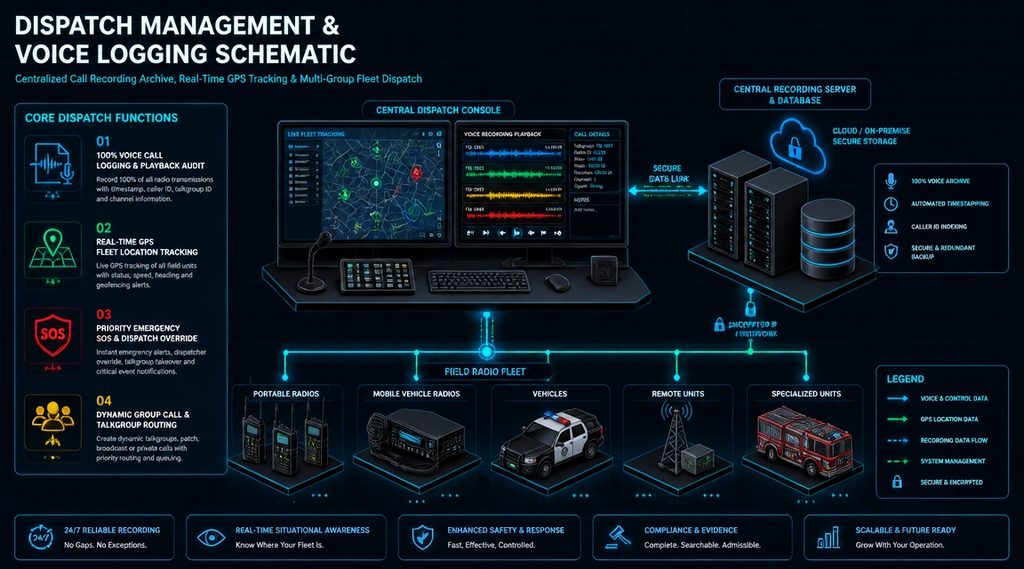
Console recording captures audio where the system can see it: at the repeater, at a gateway, or at the dispatch position.
One recorder covers many radios, with channel, talkgroup and time attached to every entry.
The cost is infrastructure. A recorder needs a server, storage, a network path and an administrator.
Both, and why that is not redundancy
Local and console recordings answer different questions. Local answers what this user heard; console answers what the channel carried.
In a dispute, the two can differ. A radio out of coverage records silence where the console recorded a call.
If the project needs both answers, budget for both. Do not assume the console covers a radio that was never on the network.
Local recording
The appeal is obvious: no server, no network, no administrator. The constraints are just as real.
How it works in practice
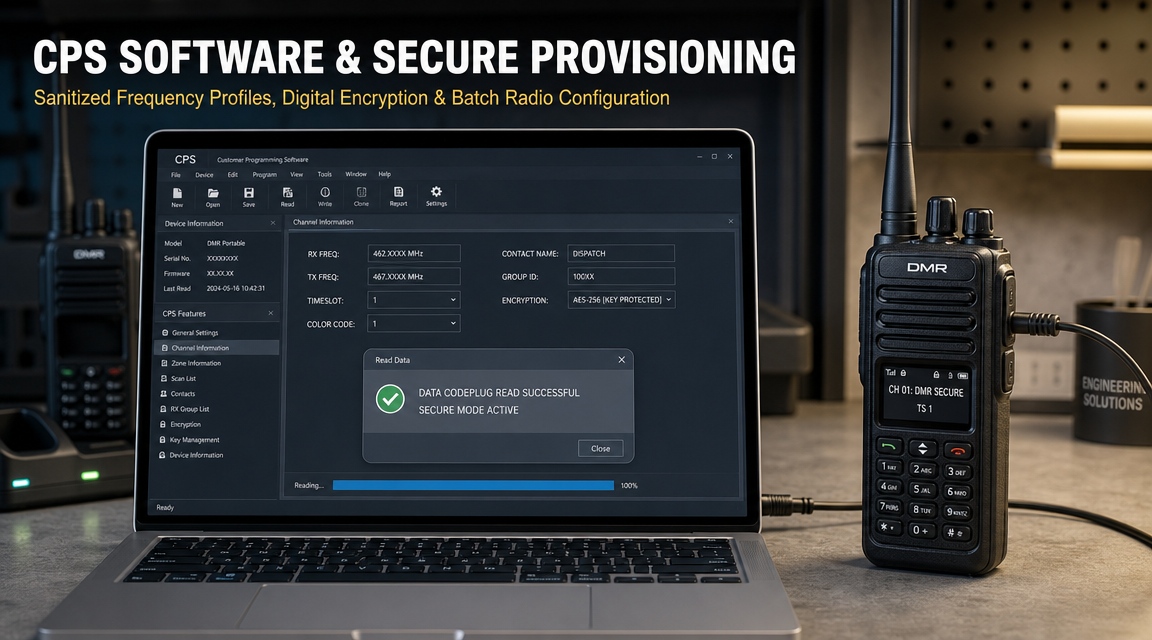
A local recorder writes to memory inside the radio. It is usually a firmware feature enabled in the programming software.
Recording can start on transmit only, on receive only, or on both. That choice changes the storage estimate by a factor of two.
Most implementations run a circular buffer. When memory is full, the oldest audio is overwritten without warning.
Ask what happens at full capacity before you rely on it. A silent overwrite is the most common cause of a missing recording.
Storage media and capacity
| Audio format | Per hour | 32 GB card | 64 GB card |
|---|---|---|---|
| PCM, 8 kHz, 16-bit | 57.6 MB | 555 h | 1,111 h |
| Compressed, 4 kbit/s | 1.8 MB | 17,700 h | 35,500 h |
The arithmetic is simple. PCM at 8 kHz and 16-bit uses 16 kB per second, which is 57.6 MB per hour.
A 4 kbit/s compressed stream uses 500 bytes per second, which is 1.8 MB per hour. That is a factor of 32.
Neither figure is a product claim. Ask the supplier which format the radio writes, then multiply.
Duty cycle changes everything
A radio does not record continuously. It records while somebody talks, and most channels are idle most of the time.
At 15 percent occupancy, one calendar day holds 3.6 hours of audio. Uncompressed, that is about 207 MB per day.
On a 32 GB card, that is roughly 150 days of retention. On a busy channel at 50 percent, it is 42 days.
Measure occupancy for a week before sizing storage. Guessing it is how projects run out in month three.
Export from a handheld
Export usually means the programming cable and the vendor tool, or pulling the card and reading it on a PC.
The vendor tool is slower and produces a tidy index. The card reader is faster and risks losing the index file.
Either way, record who exported what, when, and to which device. A file with no provenance is hard to defend later.
What local recording cannot do
It cannot prove what the network carried, because it never saw the network.
It cannot survive a lost radio, a flat battery at the wrong moment, or a user who reformats the card.
It also gives no central search. Finding one transmission among thousands of radios is a manual walk from device to device.
Card handling and card failure
Treat the memory card as a consumable, like a battery. It wears with every write cycle and it fails without warning.
Buy cards from a known source. Counterfeit cards report a large capacity and overwrite the oldest data much sooner than stated.
Keep a spare card per shift group, and log every swap. For radio voice recording, a missing card is a missing day.
Console-side recording
Console recording is where radio voice recording becomes an archive instead of a file on a card.
What actually gets captured
A recorder at the repeater captures every transmission the repeater repeats, on every talkgroup it serves.
A recorder at the dispatch position captures what the operator hears, including patch calls and telephone audio if the console handles them.
The two are not the same archive. A repeater recorder misses direct-mode traffic; a console recorder misses anything the operator was not monitoring.
Sizing the server
Start from the same per-hour figure you used for the radio, then multiply by channels, not by users.
Four channels recorded continuously at 57.6 MB per hour produce 5.5 GB per day. Thirty days of retention needs about 166 GB before overhead.
Compressed at 1.8 MB per hour, the same four channels need 173 MB per day and 5.2 GB per month.
Add the operating system, the database and a backup copy. A retention policy is a storage bill, not a checkbox.
Export and chain of custody
Good console software exports a time range, a channel and a file format in one action.
Prefer a format the other side can open without your software. A proprietary player is a barrier at exactly the wrong moment.
Record the hash of the exported file, the operator name and the time of export. That is what turns an audio file into evidence.
Retention policy
Decide the retention period before the first recording, and write it where staff can find it.
Thirty days suits incident review. Ninety days suits a disputes process. Longer periods are a legal decision, not a technical default.
Deletion should be automatic and logged. Manual deletion by an administrator is the first thing a complainant will ask about.
Buying comparison
The two architectures differ less in price than in who carries the operational risk.
Questions for the quotation
| Question | Why it decides the choice |
|---|---|
| Where is the audio stored, and on what media? | Determines retrieval and survivability |
| Which format and bit rate? | Sets the storage arithmetic |
| What happens when storage is full? | Overwrite or stop recording |
| Can a user delete or disable recording? | Affects evidential value |
| How is audio exported, and in what format? | Determines who can use it later |
| Is there an audit log of access and export? | The core of any dispute |
| What is the retention period and who sets it? | Cost and compliance together |
Cost drivers
Local recording is mostly a firmware option and a memory card. The cost scales with the number of radios.
Console recording is mostly infrastructure. The cost scales with channels and retention days, not with headcount.
That difference matters at scale. Fifty radios with local recording can be cheaper than one console with ninety days of retention.
Ask whether the recorder is licensed per channel, per seat or per server. That single line changes a three-year cost more than the hardware price.
Ask what the support contract covers after year one. Recorders fail quietly, and a silent recorder is worse than none.
Ask for a copy of the default retention setting. Many systems ship with the shortest period, and nobody changes it until the first request arrives.
Red flags
A recorder that stores only in a proprietary format is a future obstacle.
A recorder with no time source of its own will drift, and every timestamp becomes arguable.
A system where an administrator can delete a day of audio without a trace is not an archive. It is a convenience.
Integrated kits
Some vendors sell radio voice recording as a package: radios, a recorder and a small management screen.
The package is easier to buy and harder to leave. Check that the audio can be exported without the management software.
Check also whether the recorder keeps working when the management server is down. On a good day this is invisible; on a bad day it is the whole point.
Compliance reminders
This section is orientation, not legal advice. Confirm the rules for each state or country where the radios operate.
The federal frame
Two statutes matter, and they do different jobs.
18 U.S.C. § 2511(2)(d) allows a party to a communication, or someone with one party’s prior consent, to record it.
The exception in that clause is narrow but real. It does not cover recording made for a criminal or tortious purpose.
47 U.S.C. § 605(a) addresses radio directly. It bars an unauthorized person from intercepting a radio communication and from divulging or publishing its contents.
Read together, the pattern is practical. Recording your own channel for your own operations sits comfortably inside the frame.
Where exposure actually starts
The risk in most projects is not the recording. It is the sharing.
§ 605(a) reaches publication of the contents to another person, not only the act of listening.
Posting a clip, sending it to a customer, or handing audio to a third party is the moment the analysis changes.
The statute carries civil damages of $1,000 to $10,000 per violation, plus criminal exposure for willful conduct.
Notice to staff
Tell people the channel is recorded, in writing, before the first recording is made.
Put it in the handbook, on the radio issue form, and in the training that goes with the handset.
A short spoken notice on the channel is also ordinary practice. It costs nothing and removes the argument later.
Access control and audit
Name the roles that may listen to radio voice recording and the roles that may export it. They are rarely the same group.
Require a reason for export, and log it. An audit trail is the difference between an archive and a rumour.
Review access quarterly. People change roles, and permissions rarely follow them.
Retention and deletion
Keep audio for a stated period and delete it on schedule. An archive kept forever is a liability with no upside.
Suspend deletion when a claim, an injury or an investigation is open. That hold must be documented and reversible.
Deletion should be logged too. Being able to show what was deleted, and when, is as useful as showing what was kept.
Write the retention rule into the supplier contract as well. A recorder that cannot enforce a deletion schedule quietly moves the work onto your administrator.
Testing before acceptance
Test radio voice recording as an evidence tool, not as a feature. If you cannot find and export a clip, you do not have a recorder.
The three-minute test
Key a radio, say a known sentence with a number in it, and stop. Note the time to the second.
Then find that clip using only the interface a normal administrator would use. Time how long it takes.
Export it, open it on a machine without the vendor software, and check the sentence and the timestamp.
Metadata that has to be right
Every recording needs a clock that is synchronized to a real time source, and a channel or talkgroup label.
Check that the label matches the channel the user selected, not the slot number.
Check the file name too. Sorting by file name is how most people actually search an archive.
Ask for the clock source in writing. A recorder that takes time from a laptop drifts, and every later argument starts with the timestamp.
Failure modes to test
Fill the storage and confirm what happens: overwrite, stop, or an alert. The answer must match what the supplier promised.
Pull the power during a recording and check whether the file survives and whether the index still opens.
Remove a card from a handheld mid-shift. If the audio becomes unreadable, that is a design limit worth knowing before an incident.
Test one month of real traffic before rollout. A recorder that behaves on a quiet bench and trips on a busy channel is a common result.
Frequently asked questions
Do we need a license to record our own traffic?
The radio license covers transmission, not recording. Recording is governed by wiretap and communications statutes, not by the FCC license.
That is why the consent and notice questions sit with your legal advisor, not with the radio supplier.
Can a user switch recording off?
On many radios, yes. The setting usually lives in the programming software and can be locked.
If evidential value matters, lock it and log changes. A recorder the user can disable proves very little.
How much audio do we actually keep?
Less than the storage figure suggests, because channels are idle most of the day.
Measure occupancy for a week, then multiply by the per-hour rate. That number is the one to plan retention around.
Keep the occupancy figure with the channel plan. When a new talkgroup goes live, the estimate has to move with it.
Is compressed audio acceptable?
Usually yes for operations, and it is the only practical choice for long retention.
Check intelligibility on a noisy channel recording, not on a quiet test. Compression punishes exactly the audio you care about.
Where should the recorder sit?
At the repeater if the question is what the channel carried. At the console if the question is what the operator handled.
In the radio if the question is what one person heard. Most disputes are about one of those three, and rarely all of them.
Contact Us
Tell us where the audio has to live and how long it has to survive. We will quote the radio option and the recorder that fit that answer.
Radio voice recording is easy to add and hard to retrofit. Decide the architecture before the handhelds are ordered.
Contact our sales manager directly.
Sales Manager: Kevin
WhatsApp: +852 60731163
WeChat: +8616623617128
Email: fengfanannie@163.com